
Greenville Directory Collection Access
A single shelf never holds a complete Greenville run. Each collection works best as an evidence window with its own reach. Record the exact year of every volume. Note the format too. A catalog description, a physical book, and a digitized newspaper companion are not the same thing. The table below separates confirmed city directory holdings from nearby historical material. It does not imply that every Greenville residents directory volume sits online.
| Collection | Years | Where Held | Access |
|---|---|---|---|
| Delta State McCormick Collection directories | 1960, 1961, 1962, 1964-1966, 1968-1971, 1973-1975, 1981, 1985, 1987, 1989-1994, 2000-2001 | Delta State Archives Museum, Cleveland | Consult the collection guide or contact the museum |
| Polk, Polk's, and Greater Greenville variants | Annual; catalog description based on 1946 and designation begins 1946 | Mississippi Department of Archives and History | Catalog record; related microform is noted |
| Polk's directory | 1970/1971 | Mississippi State University Special Collections | Genealogy holdings and on-site research |
| Greenville Times | 1868-1917; digitized dates are incomplete | Library of Congress, supplied by MDAH | Chronicling America image and OCR search |
The Delta State years are selected years, not an uninterrupted street directory run. MDAH labels its Polk material annual. The catalog record cannot promise that every issue survives or is reachable remotely. A Greenville criss-cross collection has not surfaced in any catalog. No local library publishes a current inventory of reverse directories. None inventories obituary files, clippings, or vertical files either. Treat absence from a catalog as an open question. It is not a final answer for a resident lookup.
Greenville Directory Library Help
For directory research, the Washington County Library System offers several routes: Local History, Ask Us, Community Info, databases, and its catalog. Its Greenville branch is the William Alexander Percy Memorial Library at 341 Main Street, Greenville, Mississippi 38701, telephone 662-335-2331. The city page lists Monday and Tuesday hours of 9 to 7, Wednesday and Thursday 9 to 6, Friday 9 to 5, and Saturday 10 to 1. The county library page gives a different weekday schedule. Confirm your visit with the reference desk at wash-ref@washington.lib.ms.us instead of trusting either listing alone.
The library system page displays the local-history navigation you can browse before asking whether a specific volume, obituary file, reverse directory, or clipping file is on hand.

This route shines when the surname is known but the directory year is not. Ask for the exact year and format in one message. Then file the reply with your research notes instead of your memory. A catalog silence proves nothing about whether a Greenville city directory volume exists. It only shows the volume is not listed there.
Delta State Fills Greenville's Unusual Directory-Year Gaps
Delta State's McCormick list earns its keep. It covers odd clusters a decade-by-decade search tends to skip: 1960-1962, 1964-1966, 1968-1971, 1973-1975, then 1981, 1985, 1987, 1989-1994, 2000, and 2001. The material lives at the Delta State Archives Museum in Cleveland, reachable at 662-846-4780. Treat these as historical directories rather than a current source. A match only means a name or address appeared in that edition. Verify it against the printed page. Check companion sources before relying on it.
Mississippi State University Special Collections offers a second institutional route for genealogy. It also holds Washington County material tied to the Greenville area.
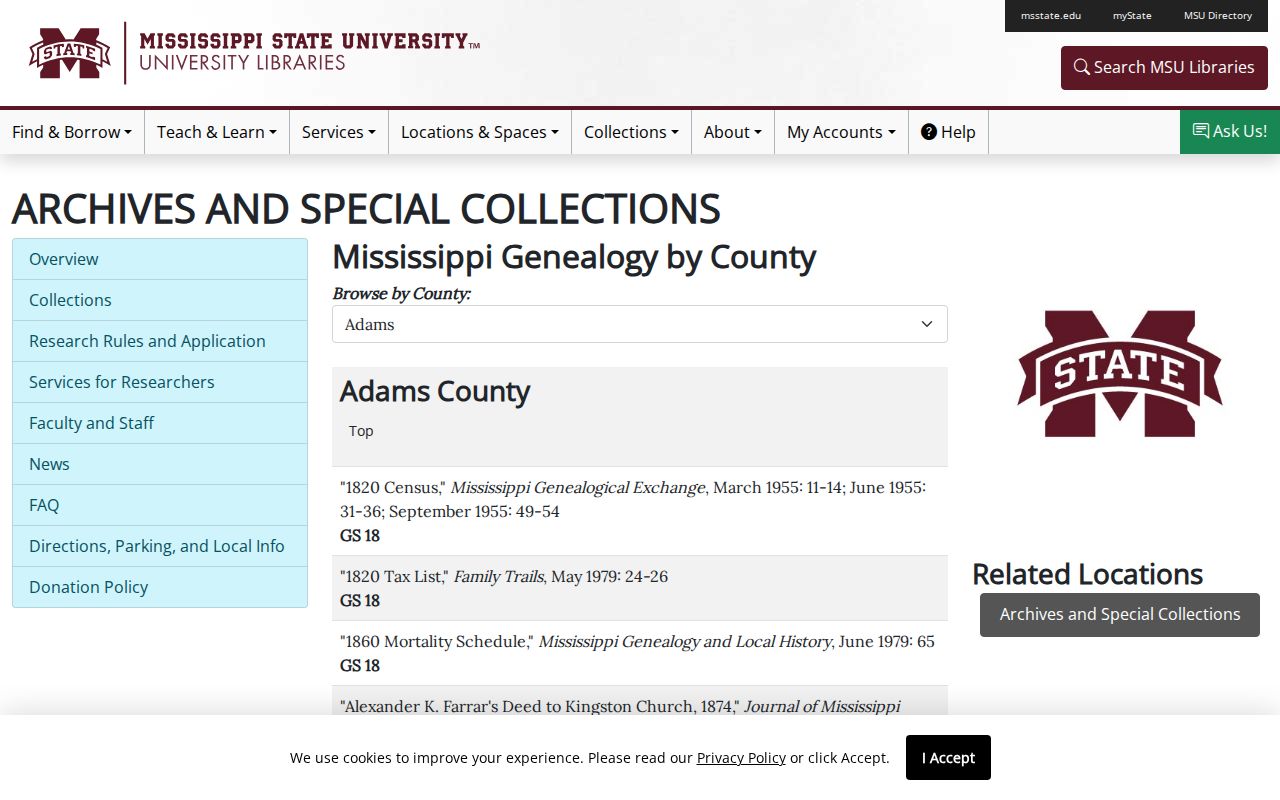
MSU's catalog goes further than Polk's 1970/1971 volume. Washington County books sit beside historical-society programs and probate and estate extracts. School publications and a 1970 Greenville Times anniversary edition round out the shelf. Those related holdings help test a directory find. They do not pretend to be duplicate directory volumes.
Polk Variants and the MDAH Microform Trail
The MDAH catalog sorts the Greenville series into Polk, Polk's, and Greater Greenville variants. R. L. Polk & Co. appears as publisher. The description calls the series annual. It builds on a 1946 issue. The span runs 1946 forward. The assigned call number is 917.62CD/Greenville, and a related microform record is noted as well. Those catalog facts mark a research path. They are no promise that any particular issue can be viewed online or borrowed. When making a request, include the title variant, the approximate year, and the call number. Say whether the goal is a name, a street, or an organization. Once the right volume is in hand, photograph or transcribe the title page and abbreviation key. That step preserves edition and publisher evidence when names or street spellings shift between volumes.
Reading Greenville City Directory Entries
No live Greenville entry is reproduced here. The fields below are a reading convention for historical directory volumes rather than a claim about every Greenville edition. Start with the edition's title page and abbreviation list. Copy the entry exactly first, keeping initials, punctuation, street spelling, and any printed notation intact. Only then interpret a mark. Check the key inside that same volume before assigning meaning.
| Personal name | Usually the entry point for a surname search; initials and suffixes can distinguish similar names. |
|---|---|
| Street address | A historical address string that should be copied as printed before it is compared with a current map or parcel. |
| Occupation or organization | Context that may separate two same-named people, but not evidence of a present address. |
| Household notation | Some directory formats may identify a spouse, widowhood, or another household relationship; check the edition key. |
| Symbol or abbreviation | Its meaning belongs to the volume’s own abbreviation list; do not carry a meaning from another publisher or year. |
- Criss-cross directory
- An address-arranged section, when a volume includes one, that can be read street by street. No confirmed Greenville criss-cross run was located.
- Householder index
- A name-oriented index that may point to the primary household or address entry; its scope depends on the edition.
- Abbreviation key
- The publisher’s guide to the shorthand used in that volume. It is often near the front matter and should be captured before interpreting an entry.
Greenville Times Directory Context
The Greenville Times sits in the Library of Congress catalog from 1868 through 1917. MDAH supplied the material. The listing covers 1,666 issues. The digitized run is incomplete, though; searchable dates run from 1874-08-08 through 1910-11-11. Greenville researchers can mine these pages for more than news.
A newspaper often holds the clues a Greenville directory lacks. Legal notices, obituaries, and election notices appear alongside advertisements and organization lists. Any one of these can attach an address or life event to a name in the residents directory. That said, the paper never replaces the directory itself. OCR text is rough. So verify every name and number against the page image before trusting it.
For Greenville family timelines, the Times works well as a cross-check. A directory disappearance can trace to a move, a death, a spelling variation, a business change, or simply a missing edition. It can show which. Record the page date and column or image reference in your timeline. One stray mention should not become a broad claim about the whole household.
Greenville Historical Shelves Beyond the Directory Volumes
The MDAH historical-society directory places the Washington County Historical Society at 166 Nowell Road in Greenville, Mississippi 38703. The society publishes no online catalog, hours, or fee schedule. Call ahead before any visit. MSU separately catalogs Washington County Historical Society papers from 1910-1915, marriage-record microfiche covering 1858-1900, and probate or estate extracts. Those items give useful depth for a family-history question, though each belongs to its own record type rather than a historical directory volume. The statewide listing confirms the Greenville location but says nothing about reading-room access or holdings.

Treat the listing as a contact lead. Ask about the surname, street, organization, or year you care about. A confirmed appointment keeps a Greenville research trip from resting on a bare listing that says nothing about current access.
Trace a Greenville Household Across Directory Years
Trace one person or address across the confirmed Greenville years. Do not assume an unbroken annual sequence. Pair an exact directory transcription with the nearest census snapshot and its enumeration-district context. The 1950 Census is itself a historical snapshot. Its release rules bar it from covering recent decades. After you locate the directory edition you need, turn to the companion guide. The Greenville past residents guide supports an address-by-address backward trail.
- Start with one confirmed directory year and transcribe the name, initials, street string, and every notation exactly as printed.
- Check the next available Delta State or MDAH year, noting changes in spelling, address, organization, and household context.
- If the selected volume contains an address-arranged portion, compare it only after confirming the edition’s own structure and key.
- Pair the time period with the appropriate historical census and 1950 enumeration-district description, recording that each is a dated snapshot.
- Use a page-image-verified Greenville Times notice, a cemetery index locator, or a probate/estate source as a separate endpoint clue.
A missing name settles nothing. A move, a different spelling, a lost volume, or a changed household format can all explain the gap in a Greenville directory. Or the gap may come from a plain omission. Keep a short timeline noting the source title, the year, the exact printed string, the address as printed, and any normalized address. Note your confidence level as well. That habit leaves room for later corrections. It also keeps a single historical record from carrying more weight than it should.
Greenville Printed Address Timeline
River-bank caving and floods reshaped Greenville's older business district. So a present street address may not line up with an earlier structure or street grid at all. A timeline separates the historical printed form from any later normalization. It also flags whether your evidence is a directory listing, a newspaper mention, a map observation, or a census snapshot. Each carries different weight as a statement about a current household.
| Exact source string | Copy the name and address exactly as the edition prints them. |
|---|---|
| Source date and title | Record the specific directory year, newspaper date, or census snapshot. |
| Normalized address | Keep a later map-style address in a separate field, never over the original wording. |
| Parcel or legal description | Add only when a property source actually supplies the connection. |
| Confidence note | Flag an address change, map gap, same-name conflict, or unverified OCR reading. |
That small record of method pays off later, when a new volume, map, or archival item shifts the interpretation of a Greenville address. It preserves the line between a documented match and a reasonable lead.