
Greenville Previous Residents Sources by Era
Match the source to the era and the question. A deed records the transfer of an interest in land. A directory or a census page places an actual household at a moment in time. Neither one, by itself, proves who occupied the house. The routes listed here are the Greenville and Washington County channels that stand on official ground, and the county publishes no online grantor or grantee index to shortcut the work.
| Source | Years | Where | Shows |
|---|---|---|---|
| Chancery deeds and indexes | Historical span not stated online | Washington County Chancery Clerk | Transfers, legal descriptions, instrument references |
| MDAH Series 2050 | 1828-1922 | Mississippi Department of Archives and History | Washington County records, including examples of chancery material |
| Broader MDAH county entry | 1799-2006 and undated material | MDAH finding aid | Original records and microfilm categories with uneven coverage |
| Greenville directories and 1950 Census | Selected directory years; 1950 snapshot | Delta State, MDAH, MSU, and census sources | Historical names, addresses, wards, and household context |
| Sanborn maps | 1887, 1890, 1896, 1905, 1911, 1915, 1925 | MDAH-cited map holdings | Building footprint, use, block, and neighboring structures |
Start with a recent parcel or recorded-instrument clue whenever the current address is solid. For a nineteenth- or early-twentieth-century question, flip the order. Go to the archival finding aids and maps first. Then check directories, newspapers, and the deed legal description against them. A gap is worth something. Label it a gap rather than papering over it with a guess. The timeline stays honest.
Greenville Previous Residents Deed Access
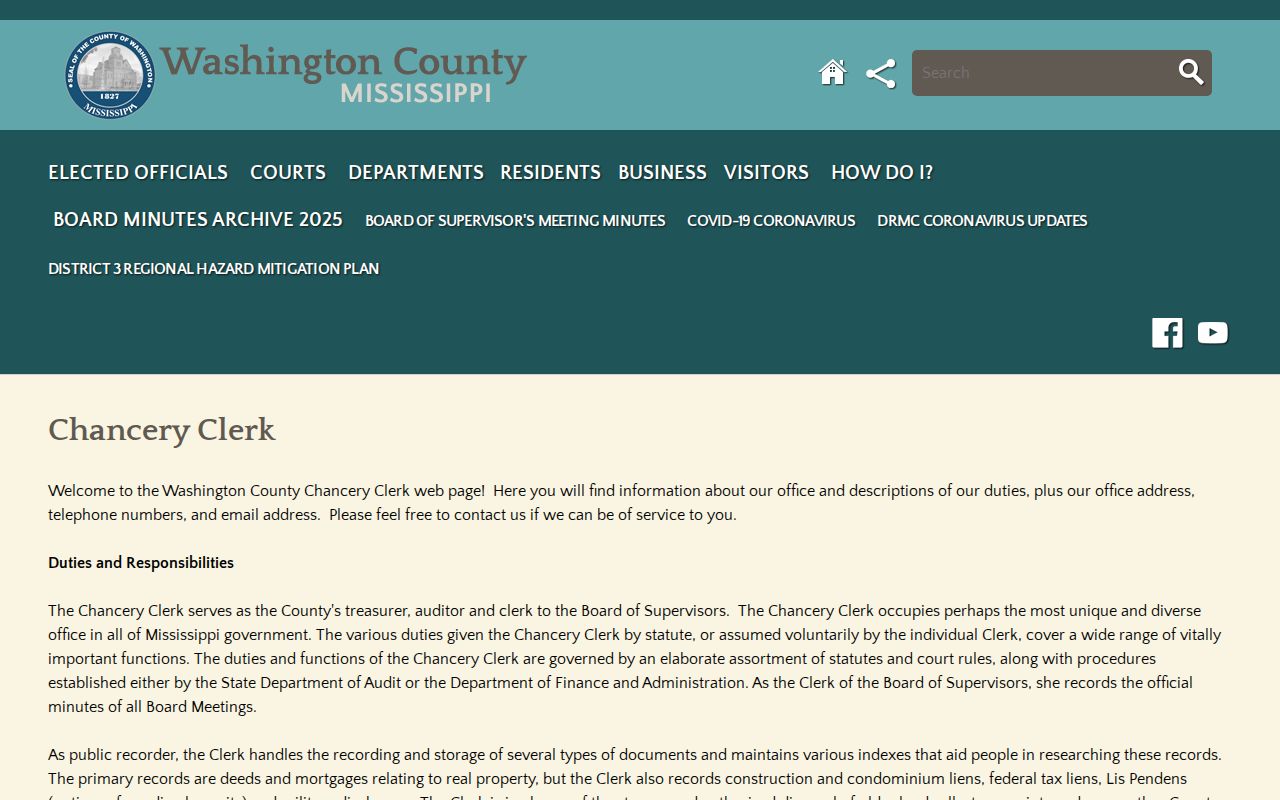
The Washington County Chancery Clerk records and indexes deeds, deeds of trust, liens, lis pendens, plats, military discharges, and other land and chancery instruments. The office sits at 900 Washington Avenue, Room 2, Greenville, Mississippi 38702, with a mailing address of P.O. Box 309. The phone number is 662-332-1595, and weekday hours run 8 to 5. Its published routes are a phone call, a written request, or a visit in person. The clerk posts no fee schedule online, so ask about copy costs before sending a request.
The Land Title Association of Mississippi office profile catalogs the index books: General Indexes for Deeds, Deeds of Trust, and Substitutions, a Sectional Index, a Map/Plat Book, liens, judgments, a Chancery Index and Docket, board minutes, and a Will Book. Its land-record online availability field reads "---". That matters. The county offers no official online grantor or grantee index and no stated coverage span, so the work happens through the clerk. The Chancery Clerk page names the office that manages the land-record route for a Greenville address history.
A request works best when it is specific. Give the clerk a grantor or grantee name, the instrument type, and an approximate year. Add a book and page or instrument number if you have one. Also include the parcel or legal description and the street address as a lead. The address helps, but keep expectations modest. An older instrument is usually indexed by names and legal description alone.
Greenville Previous Residents Deed Trail
The property trail starts with the current record. Owner of record is not the same as the person who lives there. The Washington County Delta appraisal search accepts a name, address, parcel number, alternate parcel number, or PPIN. It also takes a PPIN. The county GIS takes a property ID, address, or owner. It offers map, details, and export controls. Treat both as lead tools. Neither states its coverage dates, and county data can lag behind the courthouse.
- Record the current address string, parcel or PPIN when available, and legal description from the property records. Keep the source date beside each item.
- Ask the Chancery Clerk to locate the current owner’s acquisition instrument using the available name, approximate date, parcel, or legal description.
- Read the instrument itself. The buyer is normally the grantee and the seller is normally the grantor, but confirm those roles in the document.
- Use the prior owner’s name as a grantee search lead for that person’s earlier acquisition, then repeat the process backward through each confirmed transfer.
- Save the book/page or instrument reference and the exact legal description. If the clerk has no immediate result, revise the name, date range, or parcel information instead of assuming a missing chain.
- Grantor / grantee
- The grantor transfers an interest; the grantee receives it. The names are roles within that particular instrument.
- Chain of title
- A documented sequence of transfers for an interest in a parcel, built from the underlying instruments rather than an index alone.
- Legal description
- The parcel description used in the recorded instrument. It may remain the better match when a street number, block, or street name changed.
Greenville Deed Record Limits
A past owner may never have lived at the property. A deed of trust is a security instrument, not evidence of anyone's occupancy. A tax mailing address can point somewhere other than the property itself. Parcels get split, combined, and renumbered. Road, river, and flood changes reshape whole blocks over a century. So label every conclusion with care. Say "owner of record," "grantor," "grantee," "directory entry," or "census household." Never treat the labels as interchangeable.
House-history use. Researching past households can support family history, estate or heir questions, and curiosity about a building. Do not use the result to track, contact, or harass a living person. Mississippi records include protected categories and confidential locations; a visible field is not an invitation to republish it.
MDAH Opens a Washington County Archival Route
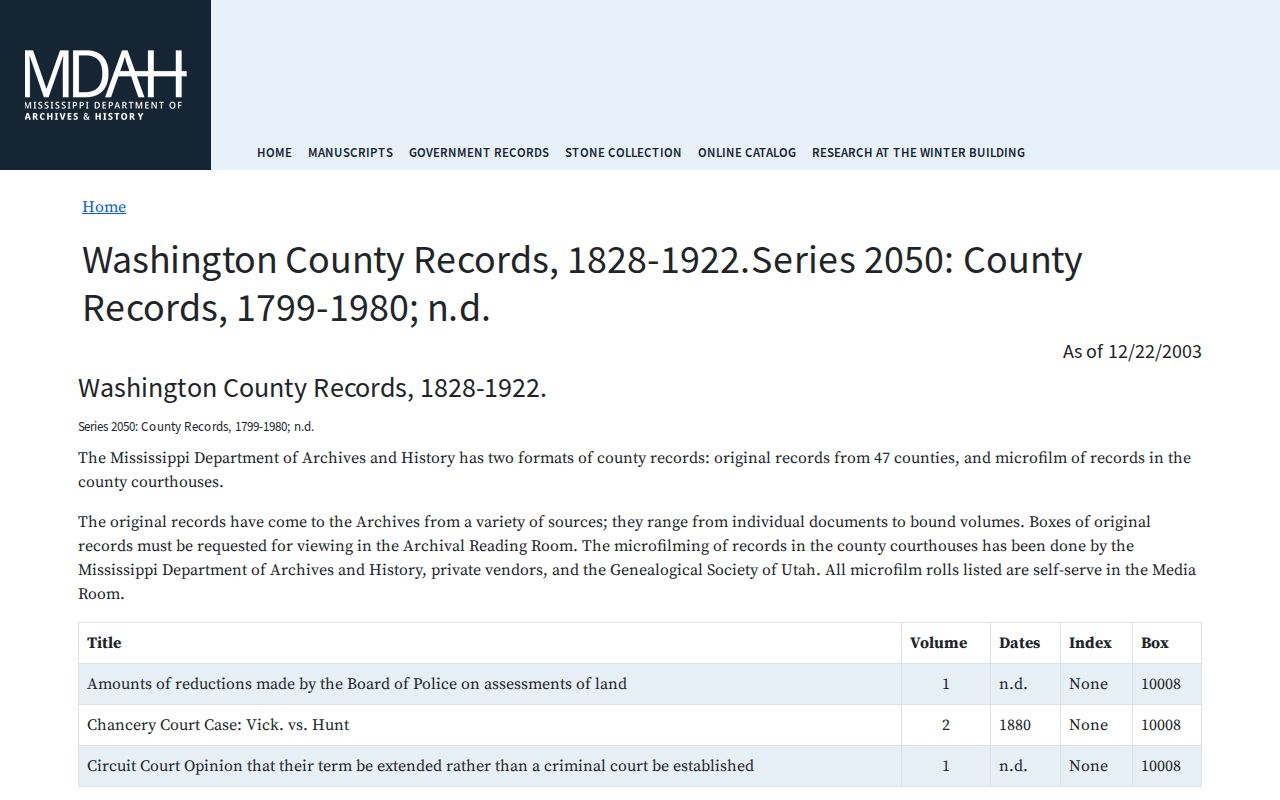
The MDAH Washington County finding aid identifies Series 2050, Washington County records, covering 1828 through 1922. It also gives 1880 chancery case material as one example. MDAH holds original records from 47 counties along with county courthouse microfilm. Format drives the workflow. Original materials are requested in the Archival Reading Room. Microfilm is self-service in the Media Room.
The county finding aid is the place to plan an archive visit. It also helps pin down the record series that fits the address.
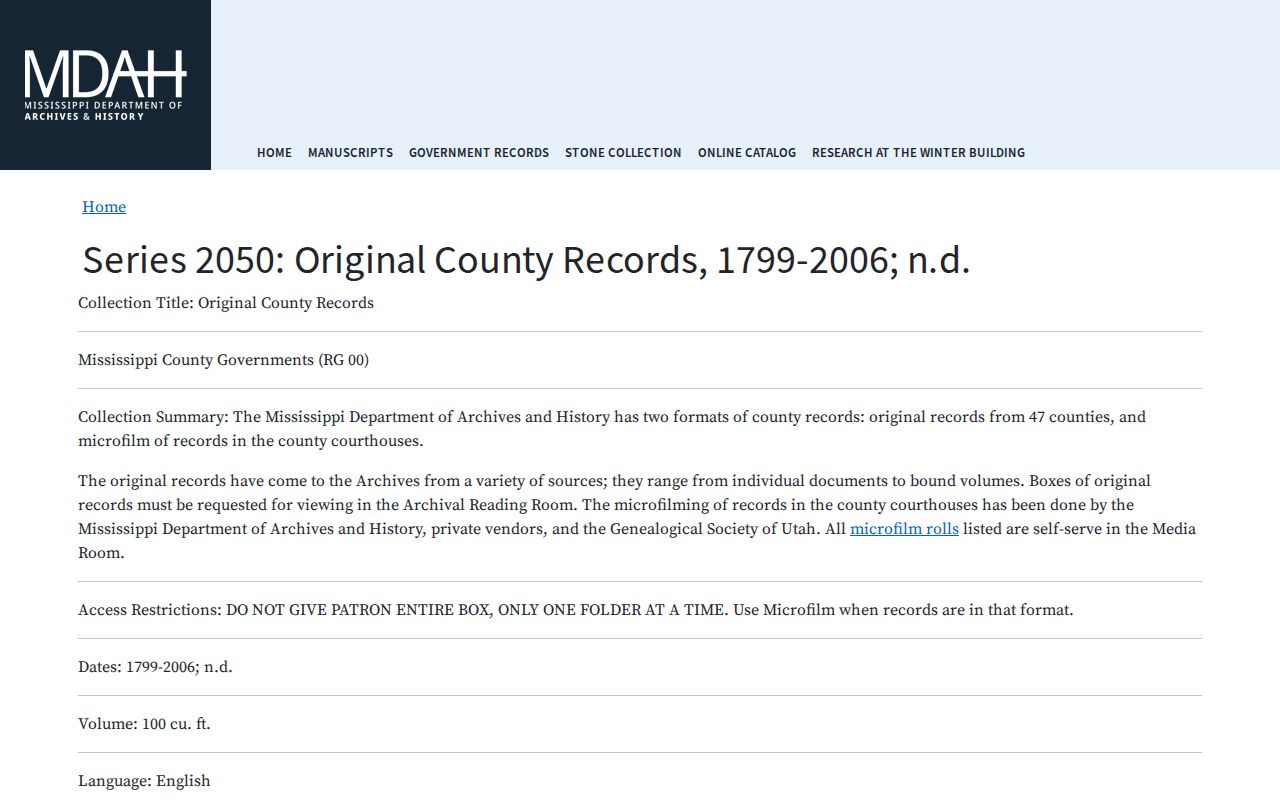
The broader entry describes original Washington County records from 1799 through 2006, plus undated material. Coverage varies sharply by record group, though. Do not read that span as a promise of full coverage. Every address, deed, or household does not appear across the whole range. Note the series, item, box or microfilm reference, and access format in the address timeline. That keeps each step traceable.
Series 2050 Gives Earlier Greenville Property Clues
The Series 2050 entry covers a broad Washington County record group. Its original material is dated 1799 to 2006 and includes undated items. It names land records for 1859/1871 and 1875. It lists court records for 1866, 1868, and 1870. It also names tax-collector microfilm number 5439 for 1827 through 1834. The patchy dates carry a lesson. An address investigation should ask for the right record group. It should not expect a continuous countywide series.
The Series 2050 record inventory displays the archival description. Cite that description before interpreting any single item.
Archival material can establish a transaction, a tax context, or a court record reference. Still, it needs the item's own metadata. It also needs the page image before it attaches to a particular address. A chain with a documented gap beats a smooth chain every time. The smooth one usually rests on assuming two like-named parties were the same person.
Greenville Digital Archive Clues
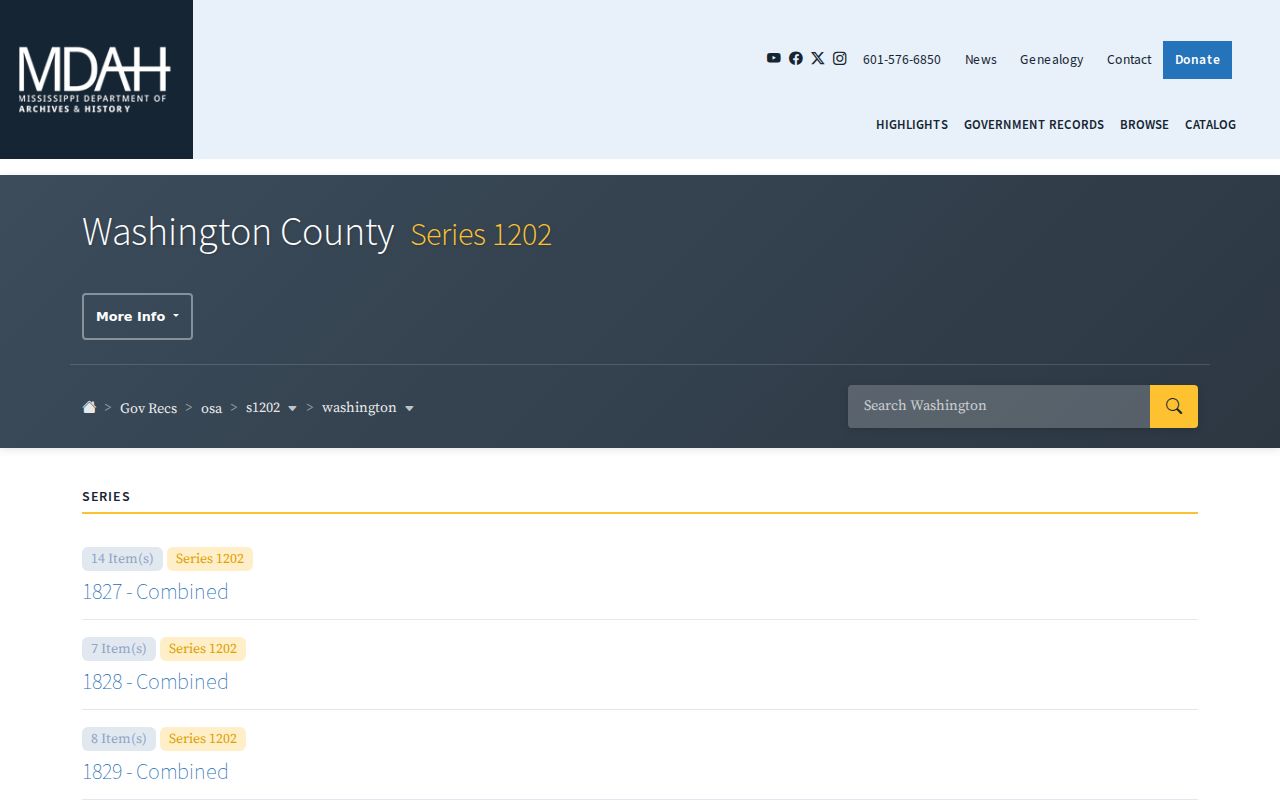
The MDAH digital archives hold a handful of Washington County series, and these are useful for tracing past residents of Greenville. Dates on file run from combined or personal records for 1827 through 1841 to land entries for 1855 and 1856. Later items include combined material from 1868, and land records from 1887. Personal records from 1895 and 1896 also appear. Each description differs. Read the item metadata closely before claiming what any image shows. These dates are landmarks, not a full address index. The MDAH digital entry page lays out the Washington County series route, so check item-level details there.
The FamilySearch Mississippi State Archives collection spans 1818 through 1952. That reach makes it a useful access route. It still cannot replace the clerk or MDAH for item-level context behind a Greenville residents directory entry.
Check any FamilySearch hit against its stated collection, image, or citation. Match it to an MDAH or clerk reference when you can. Otherwise a name match stays just a lead, not proof about one Greenville parcel or deed.
Greenville Sanborn Address History
MDAH lists Sanborn maps of Greenville for 1887, 1890, 1896, 1905, 1911, 1915, and 1925. These sheets show a building footprint, its use, and neighboring structures. They do not list occupants. The city's own historical narrative records river-bank caving and floods. Those forces reshaped the earlier business district. So a present street address may not map onto a pre-1927 structure. Earlier street grids can differ too. Test the physical setting against the map first. Then compare the legal description. Compare the exact street string in a directory. Also compare a newspaper or historic-property reference. If building, block, or street continuity stays uncertain, record that uncertainty in the timeline. Do not pin a past household to today's address.
Greenville Household History Timeline
Ownership is only one layer of household history. Delta State directories cover selected Greenville years. MDAH offers a Polk catalog route starting in 1946, and MSU holds 1970/1971 copies. The Washington County Library System routes visitors through its Local History and Ask Us services. The online local-history inventory does not enumerate exact directory, reverse-directory, obituary, or clipping holdings. Confirm a specific year with wash-ref@washington.lib.ms.us. The 1950 Census enumeration-district descriptions tie names and addresses to historical wards. They also mark the street boundaries for that snapshot. For a collection-by-collection method, see the Greenville city directory collections guide.
- Copy the address exactly from the deed, directory, census, map, or archival record before normalizing it.
- Place the source date beside the string and record the parcel or legal description if the source supplies it.
- Compare selected directory years with the nearest historical census rather than assuming names in different decades are the same household.
- Use the 1950 enumeration district to test streets and ward boundaries, then check a Sanborn map for the building and block.
- Record the source URL or archival reference, custodian, query spelling, and confidence note for every conclusion.
Each record type shows a household from its own angle. A street directory lists who lived at an address one year. Census pages, obituaries, cemetery indexes, probate files, and deeds each capture a different moment in a family's Greenville story. One source alone settles nothing. An absence might mean a move across town. It might also mean a spelling change, thin coverage, or a record that simply did not survive. Work through them all before deciding who lived where. Treat the Greenville residents directory as one thread among many.